
Don’t classify. Hallucinate!
A useful pattern for LLM classification at scale is to let it hallucinate plausible, fake entities. Then resolve to real ones.
ML engineers, data engineers, and developers building LLM-powered classification pipelines at scale
LLMs generate inconsistent lexical labels for identical inputs, but these labels are often semantically similar.
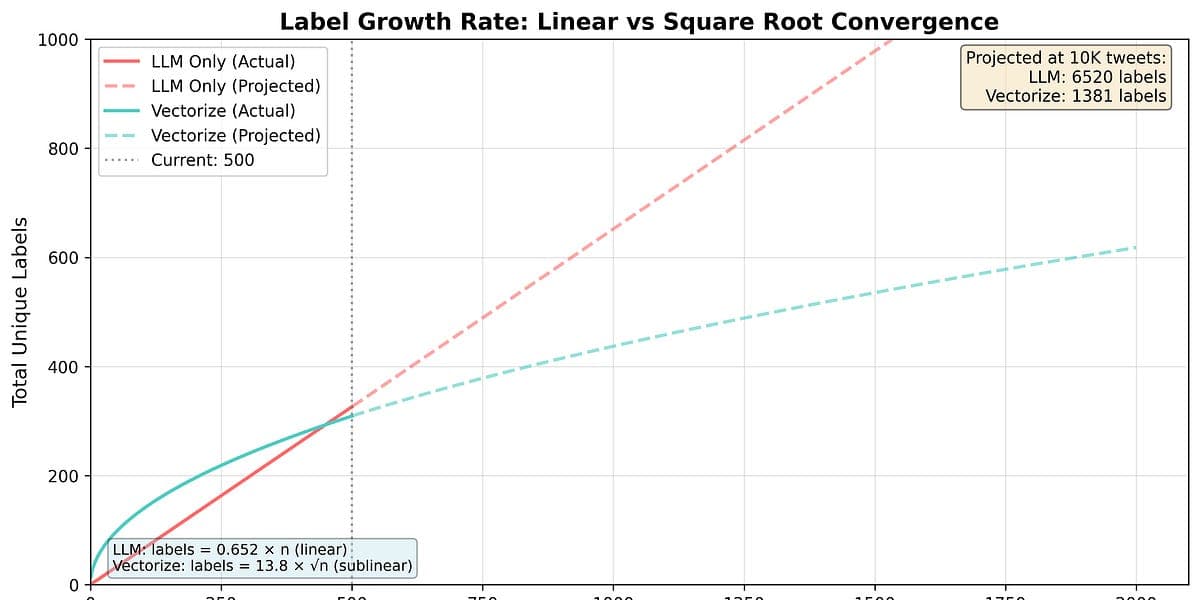
Clustering generated labels using vector embeddings and disjoint set union enables consistent classification, reducing unique labels from linear to sublinear growth as dataset size increases. This vectorization approach is initially slower and slightly more expensive, but scales to become significantly cheaper and faster than pure LLM-only classification at large volumes.
A useful pattern for LLM classification at scale is to let it hallucinate plausible, fake entities. Then resolve to real ones.